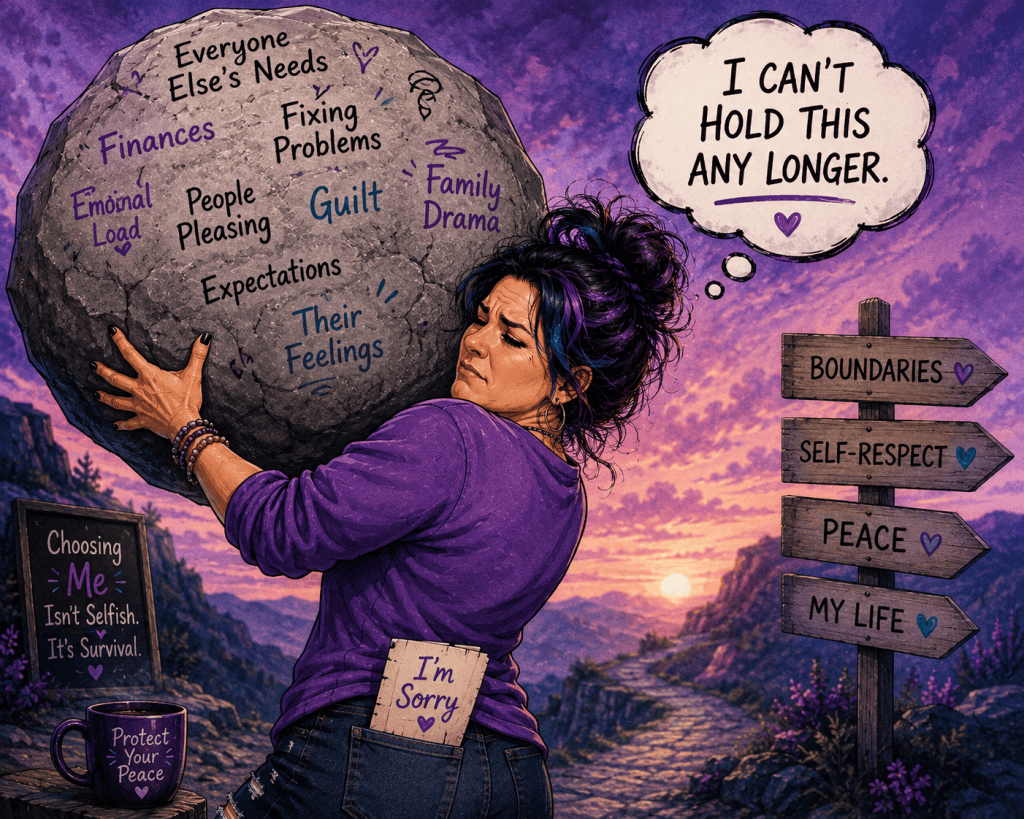
Apparently, I had gotten so good at putting everyone else first that even when I finally learned to say no, I felt the need to apologize for it.
I didn’t realize I was doing it until my therapist pointed it out.
I would set a boundary and then immediately start explaining it. Defending it. Softening it. Making sure everyone understood that I wasn’t trying to be mean, selfish, unsupportive, or whatever other terrible thing my brain had decided saying no might make me.
Basically, I had learned how to say no.
I just hadn’t learned how to shut up afterward.
For years, being supportive meant being available.
If one of my kids needed something, I tried to figure it out. If there was a problem, I wanted to fix it. If money was tight, I tried to help. If someone was struggling, I somehow found a way to make at least part of that struggle mine.
That’s what moms do, right?
Except my children weren’t children anymore.
They were grown.
And somewhere along the way, helping had quietly crossed over into something else. I was stretching myself financially, emotionally, and sometimes physically trying to make sure everyone else was okay.
The problem was that I never stopped to ask one fairly important question:
Was I okay?
For most of my life, that question would have felt selfish.
I was the mom. Moms sacrifice. Moms figure it out. Moms go without. Moms make sure everybody else has an oxygen mask before they even consider reaching for their own.
Except that’s not actually how the oxygen-mask speech goes.
You’re supposed to put yours on first.
Turns out there’s a reason for that.
I learned it the expensive way.
Several years earlier, I had co-signed for a car with my oldest daughter. The intention was good. We would get her something safe and sturdy that could last ten years, and because it was a little outside her budget, she would pay half of the payment.
Except I made a very mom mistake.
I chose the car.
I picked what I thought was safe, practical, and best for her.
She never really wanted that car.
And she never made a single payment on it.
For five years, she drove it while I paid for it.
Eventually she started telling me about dashboard lights, battery problems, and other issues that made it sound as though the poor car was approximately twelve miles away from its final resting place.
I offered different ways to get things repaired, but she wanted a new car. She thought she could use this one as a trade-in.
I saw things differently.
If the car was in the condition being described to me, there wasn’t going to be some magical trade-in fairy handing over a big check. Its value could be closer to scrap.
So I told her I would come to Texas, get the car I had been paying for, bring it back to California, and see whether it could be fixed.
She was not happy.
But the car wasn’t really the beginning of the problem.
Before all of that, after Nana moved out of my daughter’s home, my daughter fell behind on her rent. When she needed help, I bailed her out.
Then about a month later, she needed money again to avoid eviction.
This time, I couldn’t do it.
I had just moved into a house myself. Anyone who has moved into a rental knows how quickly money disappears—deposits, moving expenses, household necessities, and approximately 847 things you didn’t know you needed until you suddenly needed all of them at once.
And this hadn’t been a move I had months to financially prepare for.
I didn’t have the money to save her again.
So I said no.
And something changed.
The phone calls, which had already become sporadic, seemed to stop. Calls and texts from me went unanswered. Increasingly, it felt like I heard from her when she wanted or needed something.
And I was left with a painful question I didn’t really want to ask:
If I couldn’t fix the problem, was I still useful?
I kept trying anyway.
I worried. I called. I texted. I stressed. I tried to figure out how to have the relationship I desperately wanted with my daughter.
Until eventually I had to say a much harder no.
Not just no to the money.
No to destroying myself trying to force a relationship I couldn’t create by myself.
Because what I don’t think anyone could see at the time was that I wasn’t okay either.
I wasn’t okay financially.
I wasn’t okay mentally.
I wasn’t okay emotionally.
I was struggling.
The weight of everybody else’s problems had been piling onto my shoulders for so long that I could feel the whole damn thing starting to collapse on top of me.
And for once, instead of figuring out how to carry a little more, I finally admitted:
I can’t carry this anymore.
A few months ago, I finally got that car back.
And you know what?
That supposedly falling-apart car made the roughly 1,800-mile trip from Texas to California.
It needed work. The brakes and suspension had issues. The windshield was badly cracked, which had caused the front sensing camera to malfunction. And describing the interior as “extremely dirty” might be an act of kindness.
But she made it.
She drives nicely.
She gets good gas mileage.
And apparently she wasn’t quite ready for the scrapyard after all.
There is probably a metaphor in there somewhere.
Maybe more than one.
I still hope that someday my daughter understands what I couldn’t seem to make anyone understand then:
Saying no didn’t mean I didn’t love her.
It didn’t mean I didn’t care what happened to her.
It meant that I was drowning too.
And I finally had to put on my own oxygen mask.
Did that make me the villain in someone else’s version of the story?
Maybe.
I’m learning to live with that.
Because I would love to tell you those were the only times choosing myself has made me the villain.
But then I’d be lying.
Years ago, I had my first rental house—the first place I had really taken the time to furnish and decorate exactly the way I wanted it.
It was my home.
Nana was living with me temporarily after moving back to Texas from Tennessee. She wasn’t paying any of the household bills, and at the time, I was also paying her credit card bills.
I was trying to help.
Again.
But while I was trying to give her some breathing room financially, she was trying to change things in my house. The home I had carefully put together was slowly becoming something other than what I wanted.
Then I discovered that every dollar I was paying toward her credit cards was basically being spent again as soon as I paid it.
I was bailing out a boat while someone else was happily drilling new holes in the bottom.
At the time, I was working a travel contract in South Texas. I would be gone for a week and then home for a week, which meant that when I came home, I desperately wanted my home to feel like my home.
During one of those weeks home, I hit my breaking point.
I couldn’t keep paying the bills, watching the balances go right back up, and feeling like I was losing control of my own house.
So I left Nana a note on the refrigerator.
I explained that I loved her, but she needed to find somewhere else to live before the situation completely destroyed our relationship.
I didn’t tell her to pack her things that afternoon.
I gave her three months.
I even offered to help her move and get settled somewhere else.
What I got in return was the cold shoulder.
But the part I wasn’t prepared for was what happened with my daughter.
She was around 15 at the time, and what she heard was that I had kicked Nana out.
Not that I had been supporting her.
Not that I was paying her credit cards.
Not that the debt I was paying was immediately being run back up.
Not that I had reached the point where I was afraid the situation was going to destroy my relationship with my mother.
And definitely not that I had given her three months’ notice and offered to help her relocate.
She heard that Mom kicked Nana out.
Nana didn’t correct that version of the story.
And somehow, once again, I became the villain.
This time it cost me something I never imagined a boundary could cost me.
For almost two years, I essentially lost my oldest daughter.
She wouldn’t talk to me. My calls went unanswered. On the rare occasions when I did get to hear her voice, I got one-word answers.
I kept trying to explain.
I kept wanting someone to understand my side.
I kept thinking that if I could just explain it correctly, surely everyone would see that I hadn’t thrown my mother into the street. I had reached my limit and tried to create a boundary before resentment destroyed our relationship completely.
But nobody handed me a courtroom and invited me to present Exhibit A through Z.
There was simply their version of what happened.
And mine.
Nana and I eventually repaired our relationship.
My oldest daughter and I did too.
We had several years when I wasn’t just Mom. We were friends. We talked. We had a relationship that made me believe maybe all of that hurt was finally behind us.
But looking back, I think that earlier experience had taught me something—and unfortunately, it wasn’t the lesson I needed to learn.
Instead of learning that I was allowed to have limits, part of me learned:
Be careful. Saying no can make people stop loving you.
That’s a pretty powerful lesson to carry around.
Years later, when I decided I wasn’t coming back from California, my relationship with my daughter was severely fractured again.
And once again, choosing something I needed for my own life felt as though it had made me the bad guy.
I did what I had always done.
I tried to fix it.
I explained. I apologized. I worried. I replayed conversations in my head and wondered what I could say differently. I tried to figure out how to make everyone understand that choosing something for myself wasn’t the same as choosing against them.
I have spent years trying to repair relationships I never had the power to repair by myself.
That’s a difficult thing for me to admit.
Because the truth is:
I still struggle with boundaries.
I don’t have a huge family. The family I do have matters enormously to me, and there is still a very real part of me that is terrified that if I say no too many times, disagree too loudly, or finally say I don’t like how this is being handled, someone else will walk away.
I know where that fear comes from.
I’ve lived it.
So when my therapist pointed out that I was apologizing for setting boundaries, he wasn’t talking to a woman who had suddenly discovered the magical power of the word no.
He was talking to a woman who knew that sometimes saying no really had cost her relationships.
That’s what makes boundaries complicated for me.
I can tell myself that I’m allowed to have them.
I can tell myself that another adult’s financial problems don’t automatically belong to me.
I can tell myself that loving someone doesn’t require accepting behavior that hurts me.
I can even tell myself that I cannot single-handedly create a healthy relationship with someone who isn’t meeting me halfway.
Knowing all of that doesn’t make me less afraid.
It just means I’m learning to do it afraid.
Maybe that’s what choosing yourself actually looks like sometimes.
Not confidence.
Not some triumphant moment when you finally stop caring what everybody thinks.
Sometimes it’s saying no and then sitting with the horrible feeling that follows without immediately taking the no back.
Sometimes it’s letting someone be disappointed in you.
Sometimes it’s admitting, I don’t like how this is being handled, even when your stomach is already preparing for the fallout.
Sometimes it’s realizing that you can love someone deeply and still refuse to carry something that belongs to them.
And sometimes it’s accepting the hardest truth I’ve had to learn:
I can work on my side of a relationship. I cannot do both sides.
I still hope for healing in the relationships that are fractured.
I still want my family in my life.
I still worry that choosing myself will make someone decide I’m selfish, difficult, unsupportive—or once again, the villain in their story.
Maybe someday that won’t scare me as much as it does now.
But I’m not there yet.
What I am learning is that fear can’t keep being the reason I abandon myself.
So yes, sometimes I still say no and want to apologize for it.
Sometimes I probably still do apologize for it.
I’m a work in progress.
But at least now I’m beginning to understand that choosing myself doesn’t mean I stopped loving them.
It means I’m finally learning that loving them doesn’t require losing me.


Leave a Reply