I have recently discovered something shocking.
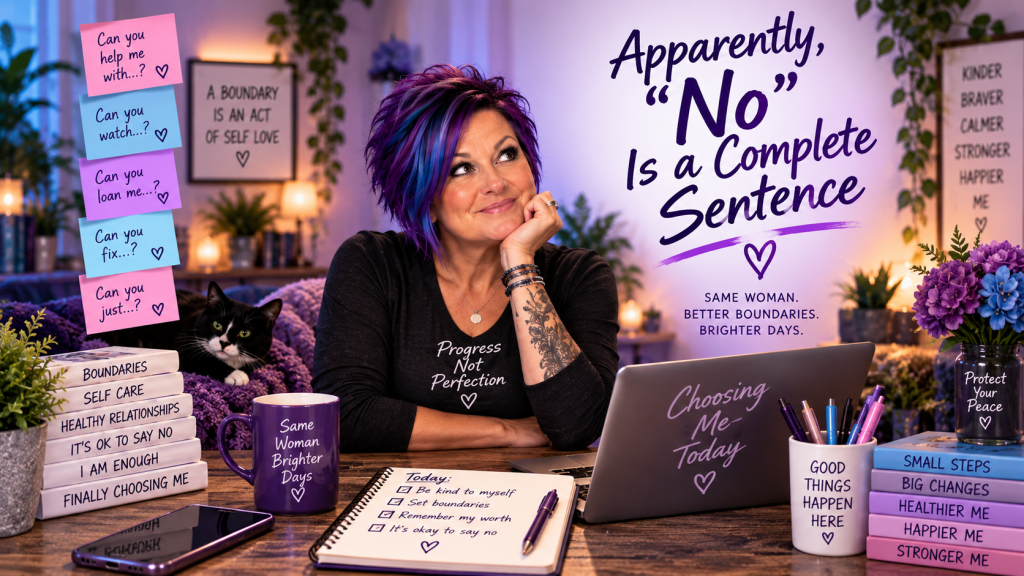
Apparently, “No” is a complete sentence.
You don’t have to follow it with a paragraph.
You don’t need three supporting documents.
You don’t need to provide your financial records, work schedule, current stress level, or a detailed explanation of why the answer is no.
You can just say it.
No.
This was news to me.
Because for most of my life, my version of “no” sounded more like:
“I really wish I could, and normally I absolutely would, but here’s the entire list of circumstances preventing me from doing it this time, and I’m really sorry, and please don’t be mad at me.”
In other words, I wasn’t setting a boundary.
I was submitting an application for permission to have one.
I Was the Fixer
I was really good at taking care of people.
Need something?
I’ll figure it out.
Something went wrong?
Call me.
Financial problem?
Let me see what I can do.
Crisis?
Well, move over. Apparently, I work here now.
For a very long time, being needed made me feel valuable.
And when you’re used to being the person everyone can count on, there’s a strange thing that happens when you finally start saying no.
People don’t always like it.
And even worse?
Sometimes you don’t like it either.
The guilt can be brutal.
I could say no to something I absolutely knew I shouldn’t do and then spend the next several hours wondering whether I was a terrible mother, daughter, family member, or human being.
Sometimes I would explain my boundary.
Then explain the explanation.
Then apologize for the explanation.
I was very thorough.
Then My Therapist Pointed Something Out
At some point, my therapist noticed that I kept apologizing for my boundaries.
Not necessarily because I’d done anything wrong.
Just because I’d had one.
That was uncomfortable.
Because once somebody points something like that out, you start hearing yourself do it.
No, I can’t do that, I’m sorry.
I need some time to myself, I’m sorry.
I can’t afford to help with that, I’m sorry.
Apparently, somewhere along the way, I had decided that taking care of myself required an apology.
And that was a problem.
The Oxygen Mask Finally Made Sense
We’ve all heard it.
If the oxygen masks drop on an airplane, put yours on before helping someone else.
I understood the instructions.
I just apparently thought they applied to everyone except me.
Because my approach to life had been more like:
Help everybody else with their masks.
Make sure they’re comfortable.
Ask whether anybody needs a snack.
Check on everyone one more time.
And then, if there’s any oxygen left…
Maybe I’ll have some.
The problem with living that way is eventually you run out of air.
And I was starting to realize that constantly rescuing everyone else wasn’t just exhausting me.
Sometimes it was preventing them from learning that they could handle things themselves.
That one was harder to accept.
Knowing This Doesn’t Make “No” Easy
Here’s the part where I’d love to tell you that I learned all of this, embraced healthy boundaries, and now confidently say no without giving it another thought.
That would be a lovely ending.
It would also be bullshit.
No is still hard for me.
Really hard sometimes.
I can understand intellectually that I have the right to set a boundary and still feel that familiar knot in my stomach when it’s time to actually set one.
Because underneath the guilt is something much bigger.
Fear.
I don’t have a huge family.
The family I do have matters enormously to me.
And there is a very real part of me that worries that if I say no too many times, stop fixing enough problems, or stop being the person who always comes through, eventually someone might decide they don’t need me anymore.
Or worse, that they don’t want me anymore.
That’s a difficult thing to admit.
Because it’s much easier to write something inspirational like, “The people who really love you will respect your boundaries.”
Maybe.
But when you’re the one who has to risk the relationship, inspirational sayings don’t make that fear disappear.
Sometimes my brain still tells me:
Just do it.
Just give them the money.
Just fix it.
Just say yes.
It’s easier than upsetting anyone.
And underneath all of those thoughts is the one I don’t always want to acknowledge:
What if saying no makes them leave?
I’m Learning to Let People Be Unhappy With Me
This might be one of the hardest things I’ve ever had to learn.
Someone I love can be disappointed in my decision without my decision being wrong.
They can be angry with me.
They can think I’m being unfair.
They can wish I had said yes.
And I don’t necessarily have to fix any of those feelings.
That is extremely uncomfortable for a lifelong fixer.
There are still times when I want to chase after someone with an explanation until they understand that I’m not saying no because I don’t love them.
I’m saying no because sometimes loving someone and rescuing them are not the same thing.
And I’m still learning that loving myself has to count too.
Some Days I Still Give In
I think this is important to say.
I don’t hold every boundary perfectly.
Sometimes guilt wins.
Sometimes fear wins.
Sometimes the fixer in me grabs the steering wheel before the healthier version of me even realizes we’re going somewhere.
And sometimes I say yes when I know I should have said no.
The difference now is that I recognize it.
I’m starting to notice when I’m helping because I genuinely want to help and when I’m helping because I’m terrified of what might happen if I don’t.
Those are not the same thing.
And that’s probably one of the biggest changes in me.
I’m not fearless.
I’m becoming aware.
Choosing me doesn’t mean I’m willing to lose my family. The truth is, I’m terrified of that.
It means I’m trying to believe that I shouldn’t have to lose myself in order to keep them.


Leave a Reply